
Success
Subscribed successfully.

Blog
Running a school is about much more than teaching students. Every day, schools manage admissions, attendance, fee collection, examinations, staff records, timetables, and communication with parents. When these tasks are handled manually, they can take a lot of time and increase the chances of mistakes.
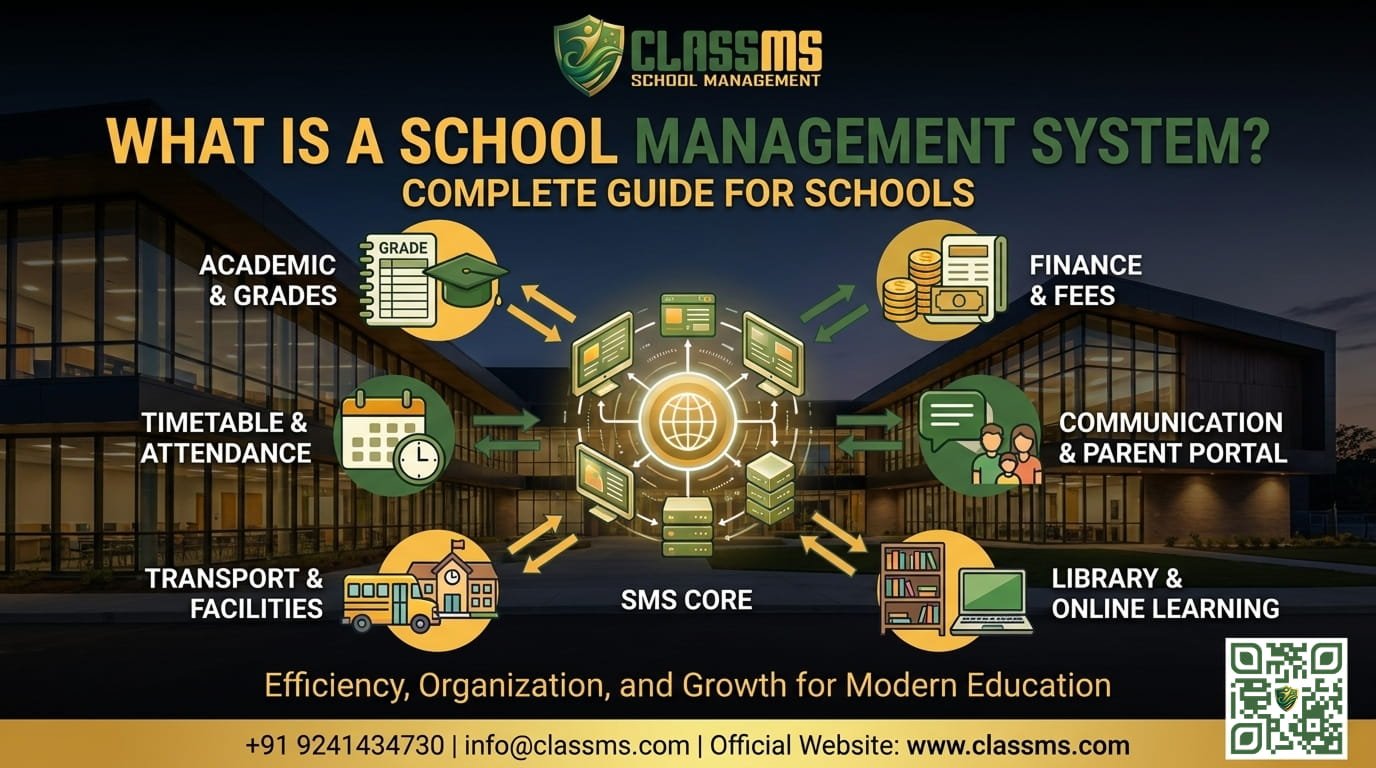
A School Management System is designed to solve these problems. It helps schools manage their daily operations digitally, making work faster, easier, and more organized.
In this guide, we will understand what a school management system is, why it is important, its key features, and how it benefits schools.
A School Management System is software that helps schools manage academic and administrative activities from one platform. Instead of using paper registers and multiple files, schools can store and access information digitally.
It allows school administrators, teachers, students, and parents to stay connected while making daily school operations more efficient.
Whether it is a small private school or a large educational institution, a school management system helps reduce manual work and improve productivity.
As the number of students and staff grows, managing school operations manually becomes more difficult. Searching for records, preparing reports, and keeping track of fees or attendance can take hours.
A school management system simplifies these tasks by organizing everything in one secure platform. It saves time, reduces paperwork, and helps staff focus more on education instead of administrative work.
The software stores student details such as admission records, personal information, class details, academic history, and contact information in one place. This makes it easy to search and update records whenever required.
Teachers can mark attendance digitally within minutes. The system automatically maintains attendance records and generates reports whenever needed.
This helps schools monitor attendance accurately and reduces manual effort.
Managing school fees manually can be challenging.
A school management system keeps track of fee payments, pending dues, receipts, discounts, and payment history. It also makes it easier to generate financial reports.
Preparing report cards manually requires a lot of time.
With a school management system, teachers can enter marks, calculate results automatically, and generate report cards quickly with fewer chances of calculation errors.
Schools can maintain employee records, attendance, leave details, and payroll information in one place. This makes staff administration much more organized.
Parents want regular updates about their children’s education.
A school management system allows schools to share important notices, attendance updates, exam results, homework, and announcements quickly, improving communication between schools and parents.
School administrators often need reports for decision-making.
The software can generate reports related to admissions, attendance, fees, examinations, and student performance within seconds.
Many routine tasks become automated, allowing teachers and administrators to complete their work much faster.
Digital records reduce the need for physical files and registers, making information easier to manage.
Automation minimizes human errors in attendance, fee calculations, and report generation.
All school information is stored in one centralized system, making it easy to find and update records.
Teachers, parents, students, and administrators stay connected through a single platform, ensuring important information reaches everyone on time.
With detailed reports and organized data, school management can make informed decisions for future planning and improvements.
A school management system is useful for everyone involved in school operations, including:
Each user can access the information relevant to their role, making the system secure and efficient.
ClassMS is a modern School Management System developed to simplify school administration. It brings together essential school operations into one easy-to-use platform, helping schools work more efficiently.
With ClassMS, schools can manage admissions, student records, attendance, fee collection, examinations, report cards, staff information, and communication from a single dashboard. Instead of spending hours on repetitive administrative work, teachers and staff can complete tasks quickly and focus more on student learning.
ClassMS also helps school management stay organized by providing accurate records, useful reports, and easy access to important information whenever it is needed. Whether a school is just starting its digital journey or wants to improve its existing processes, ClassMS offers a practical solution that supports smooth day-to-day operations.
Before selecting school management software, schools should consider the following points:
Choosing software with these features can help schools manage their operations more effectively in the long run.
A School Management System is no longer a luxury—it has become an essential tool for modern schools. It helps simplify daily operations, reduces paperwork, improves communication, and saves valuable time for teachers and administrators.
By adopting a reliable solution like ClassMS, schools can streamline their administrative work, improve efficiency, and create a better learning environment for students. As education continues to become more digital, investing in the right school management system is a smart step toward building a well-organized and future-ready school.
Write your Comment
Comment not available